


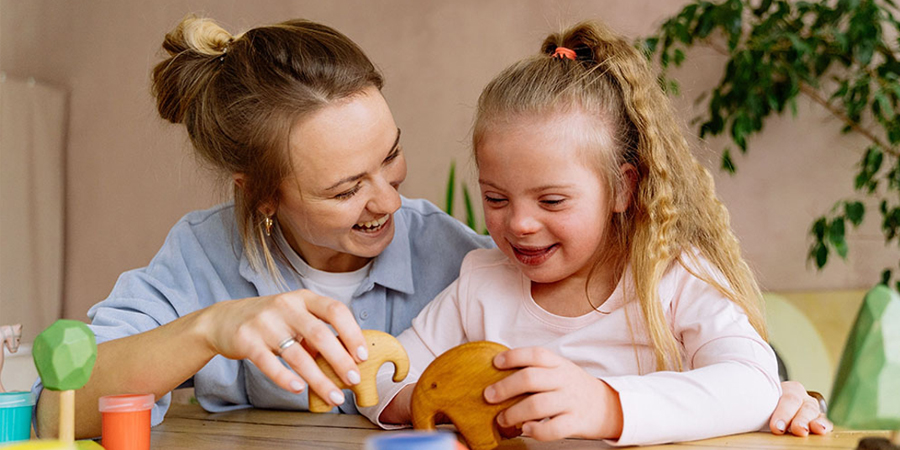
Does this sound familiar?
The family is visiting, and your child is enjoying playing nearby. Earlier in the week, you heard them recite all of the colors of the rainbow, and you are excited to show everyone what your child can do! You gather your family members nearby and tell your child to “Say your colors”, or perhaps you ask them, “What color is the apple?” Everyone watches on, anticipating your child’s answer with bated breath. With all eyes on them, your child looks around, looks at you, shrugs, and goes back to playing.
“I know they can say it, why won’t they?” I can assure you, it is not due to laziness, stubbornness, or a desire to ‘be difficult’.
One of the most common things I hear parents of clients say is that their child talks ‘but only when they want to’ or that they answer questions, ‘but only on their terms.’
Your child knows a lot. And it’s only natural that you would want them to demonstrate the knowledge and language skills that you know they have! However, the common practice of telling a child to demonstrate their knowledge, say a specific word, and perform verbally is often met with silence, shyness, reticence, and disengagement.
In other words, when we tell our kids to show their language skills, we actually make it less likely they will show the skills. This is especially true for young speakers and those with language delays. Why might this be? There are several reasons, the 3 most concrete of which are the following:
- It puts unnecessary pressure on ‘performance speech.’
- It’s an ‘unnatural’ kind of interaction
- It doesn’t feel fun or meaningful
Performance speech is the use of language to ‘perform’ a task, in this case, the task of providing a rote answer to a question and speaking a specific word or phrase in front of audience members (i.e., all of the on-looking family members). In the same way that some of us get stage fright when all of the spotlights are on us, your child may feel uncomfortable and ‘put on the spot’.
This is unnatural in the sense that this is not how we typically interact using language. Your child learns the expectations of how your family and your wider community use language by witnessing how adults use language.
Most of the language that you use daily probably consists of recalling and narrating events, describing objects and actions around you, joking with loved ones, stating preferences, and making choices. Performance speech, however, removes your child from the regular interactions already going on.
Aiming for fun and meaningful language interactions is not simply to bring a smile to your child’s face (though that’s a plus!). We know that kids literally learn more effectively and engage more when interactions are enjoyable and clearly relevant to interactive contexts. Performance speech effectively ‘quizzes’ your child. Not only might this not be particularly fun for your child, but it also tends to remove them from a more enjoyable interaction, such as play or more typical dialogue with friends and family.
So, what can we do instead to better support our child’s language development and to encourage them to actually show the skills you know they have?

Show, Don’t Tell.
As a speech therapist, I often apply the rule of “Show, Don’t Tell”. In other words, I do not tell a child to say or do XYZ. Instead, I model, or show, the expectation myself, and create interactions in which there is a meaningful reason for the child to use the word or phrase I’d like them to practice.
‘Tell me what color the apple is!’ may put pressure on a child and leave them wondering why we are suddenly talking about colors when we were just having a perfectly good game of pretending to go to the grocery store.
Instead, during our play, I show the child that colors are relevant by talking about them myself in the context of the activity (‘This red apple is juicy! But this brown apple is rotten! I put a red apple in…a red apple in…a…BROWN apple in! Ew, get outta here, rotten brown apple!). Since I’ve shown that talking about colors is, in fact, an important part of our play, the child is much more likely to want to use color words. Not only that, but they are also much more likely to give more attention to the words I’m using, since my sentences are always related to the activity they are engaged in. This makes it a great tool for teaching new words, in addition to encouraging the use of the vocabulary already commanded by your child.
You can use ‘Show, Don’t Tell’ for most interactions.
- Pretend play (“I’m a captain now. Captains drive boats. I’m driving my boat over a big wave because I’m the captain.”)
- Reading picture books together (“This bed was too hard. Ow! The hard bed hurt her back. That is too hard.”)
- Daily routines (“I pick up my toothbrush. The toothbrush has bristles. The toothbrush’s bristles are asking for toothpaste. Okay! Toothpaste goes on the bristles!”)
For all of these examples, actively engaging with your child will be much more engaging, effective, and educational than “Tell me what a captain does,” or “Tell me about the bed,” or “What do we do with the toothbrush?”
Kids can learn how to grow their language by observing the language use of those around them. The more we show them, the more they can learn! So the next time you want to tell your child to practice their vocabulary, play with them, and show them the answer. As they see you talking in fun and meaningful ways, the more they will want to talk! And the more of a reason they will have to practice using the vocabulary you have shown them!